Salesforce Spring '26 Release: Top Features Every Business Should Know

Salesforce Spring '26 Release: Top Features Every Business Should Know
Introduction
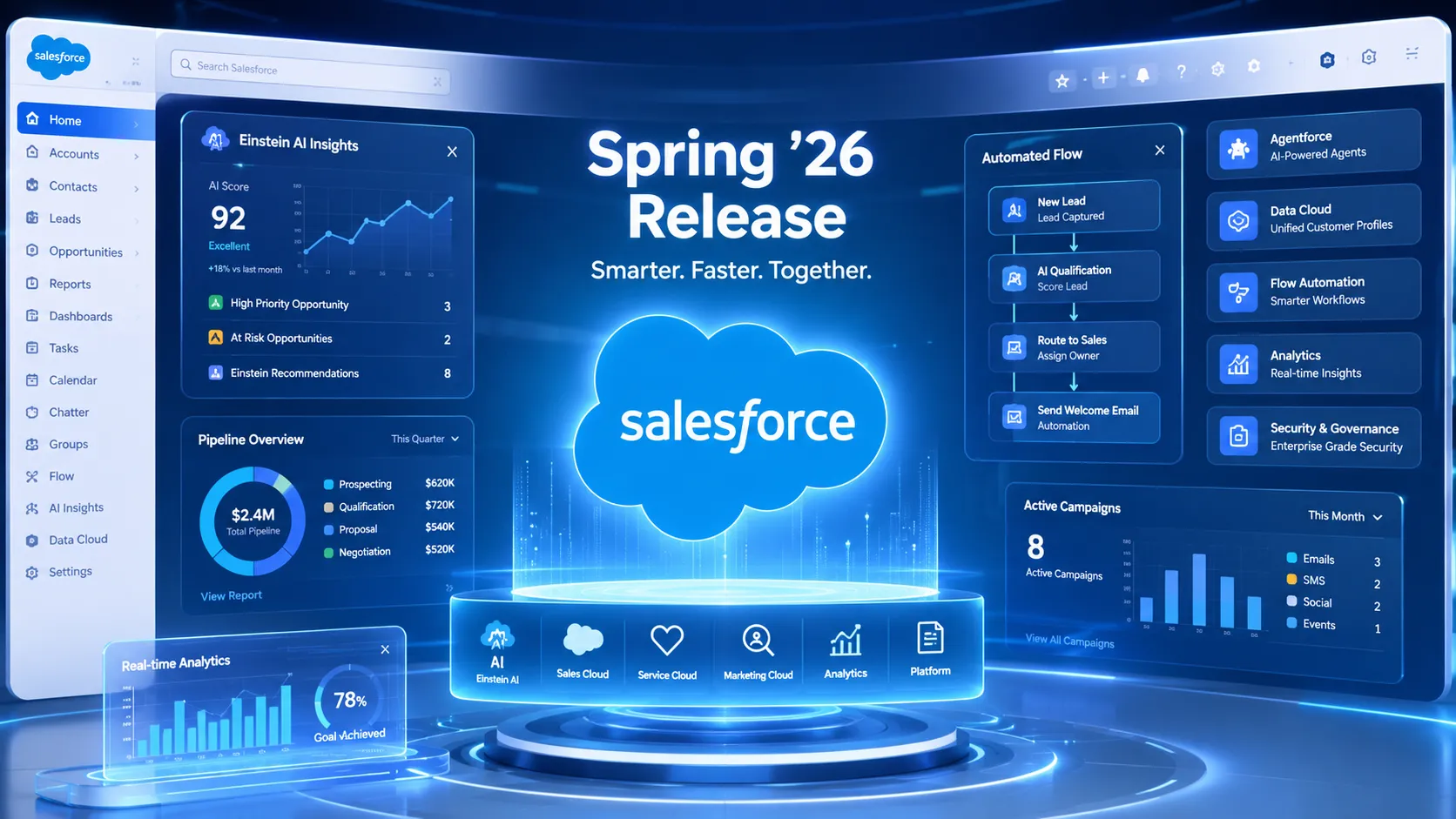
Every Salesforce seasonal release brings innovations that help organizations become more productive, automate repetitive work, and deliver better customer experiences. The Spring '26 Release continues this trend by introducing enhanced AI capabilities, smarter automation, deeper Data Cloud integration, and usability improvements across the Salesforce Platform.
Whether you're a Salesforce Administrator, Developer, Consultant, or Business Leader, understanding these updates will help you maximize your CRM investment.
1. Smarter Agentforce AI
Salesforce continues expanding Agentforce, allowing organizations to deploy AI-powered agents capable of handling customer interactions, answering internal questions, generating summaries, and assisting sales representatives.
What's New
Improved reasoning capabilities
Better business knowledge grounding
Faster response generation
More configurable AI actions
Improved security and governance
Business Benefits
Reduced support response time
Increased employee productivity
Better customer satisfaction
Lower operational costs
2. Enhanced Salesforce Flow
Flow continues replacing legacy automation tools.
New Enhancements
Faster Flow execution
Better debugging tools
More reusable components
Enhanced error handling
Improved Flow Builder performance
Why It Matters
Organizations can automate complex approval processes, employee onboarding, customer notifications, and business workflows with less custom Apex code.
3. Data Cloud Improvements
Salesforce continues investing heavily in Data Cloud.
Spring '26 introduces:
Faster data ingestion
Better identity resolution
Improved segmentation
Real-time customer insights
Enhanced AI-ready datasets
Businesses can now build richer customer profiles by connecting information from multiple systems into one trusted source.
4. Sales Cloud Productivity
Sales teams receive several enhancements that reduce manual work.
Highlights
AI-generated meeting summaries
Opportunity health scoring
Smarter forecasting
Better pipeline visibility
Improved account insights
Sales representatives spend more time selling instead of updating CRM records.
5. Service Cloud Enhancements
Customer support teams benefit from:
Faster case routing
AI-generated replies
Intelligent knowledge recommendations
Better omni-channel experiences
Enhanced service analytics
Support agents can resolve customer issues more quickly while maintaining consistent service quality.
6. Marketing Cloud Updates
Marketing teams gain more intelligent campaign management.
New Features
AI-powered content recommendations
Improved customer journey optimization
Better segmentation
Enhanced personalization
Campaign performance insights
This enables organizations to deliver highly personalized experiences across email, SMS, mobile, and web.
7. Developer Experience Improvements
Developers also receive several productivity enhancements.
Improvements Include
Better DevOps integrations
Faster deployments
Enhanced Apex debugging
Improved Lightning Web Components tooling
Better VS Code support
Development teams can deliver features more quickly while maintaining code quality.
8. Security & Governance
Security remains a top priority.
Spring '26 introduces additional governance capabilities, including:
Enhanced permission management
Better audit logging
Improved data protection
Stronger AI governance controls
More flexible compliance settings
These updates help organizations meet enterprise security requirements while confidently adopting AI.
Best Practices Before Upgrading
Before enabling Spring '26 in production:
Review the Release Notes.
Test changes in a Sandbox environment.
Validate custom Flows and Apex.
Review third-party package compatibility.
Train end users on new features.
Enable AI features gradually.
Why This Release Matters
The Spring '26 Release is more than a collection of new features—it reflects Salesforce's continued focus on AI-driven productivity, automation, and unified customer data.
Organizations that adopt these capabilities early can:
Improve operational efficiency
Deliver faster customer service
Increase sales productivity
Automate repetitive tasks
Build more personalized customer experiences